
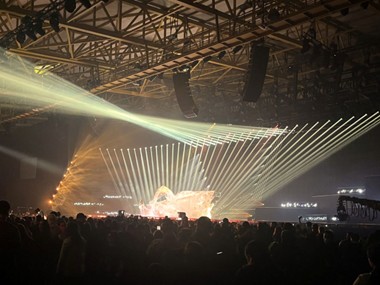
Imagine a live television production followed by millions of viewers across Europe. On stage, 18 young artists; behind the scenes, hundreds of crew members, directors, and technicians whose work depends on one thing: rock-solid connectivity. This all takes place in an extremely high-density environment, where radio bands are saturated with signals from hundreds of devices, and the margin for error is zero. Any network downtime poses a risk of interrupting the show or causing issues with the voting system. Here is how engineers from Digital Technologies and SkyTel, utilizing Cambium Networks technology, built a digital backbone for the Junior Eurovision Song Contest 2025 in just a few weeks.
An Extreme Challenge: A Multi-Week Project Window
Designing a network for an event of this magnitude typically requires months of preparation. In this case, the team had only six weeks for full deployment! The situation was further complicated when the event venue was changed just four weeks before the broadcast. Engineers had to design the infrastructure from scratch in an initially empty hall, coordinating efforts with stage design, TV production, and visual effects teams.
In such conditions, there was no room for experimentation. Cambium Networks was chosen because the ability to rapidly implement proven, high-performance, and reliable solutions was critical. The team required a solution that could be quickly planned, configured, and deployed under immense time pressure.
“The ability to design and implement complex, high-availability projects in a very short time was the key factor in selecting Cambium Networks equipment,” says Zviad Lanchava, Department Manager at Digital Technologies.
This is the moment where engineers verify the true value of marketing slogans like “reliability” or “high performance.”
The Power of XV3-8 and XV2-2: Stability Indoors and Out
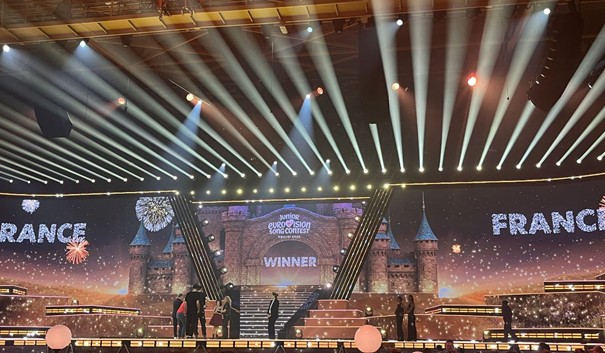
The core of the indoor infrastructure consisted of 34 XV3-8 Tri-Radio Wi-Fi 6 access points. These are enterprise-grade devices designed to handle a massive number of concurrent clients. Meanwhile, 10 weather-resistant XV2-2 Outdoor units provided coverage outside the venue.
The most compelling aspect of this configuration was the implementation of a 1+1 redundancy model. Every critical network element had an active “understudy,” ensuring that even physical damage to a single access point would not disrupt the production crew or the vote-counting systems.
Wi-Fi 6E as an Ace Up the Sleeve: Utilizing the XE3-4 Model
To meet mission-critical requirements, 16 XE3-4 Indoor Tri-Band Wi-Fi 6E access points were deployed. The Wi-Fi 6E standard provided more “breathing room” thanks to the expanded 6 GHz band, which suffers from significantly less interference from legacy devices. The XE3-4 model, featuring three radios and Software Defined Radio technology, allows the network to dynamically adapt to a shifting RF environment – an invaluable asset in a hall packed with electronics. As a result, every crew member was guaranteed a stable 50 Mbps connection.
Critical Systems Based on Wireless Connections
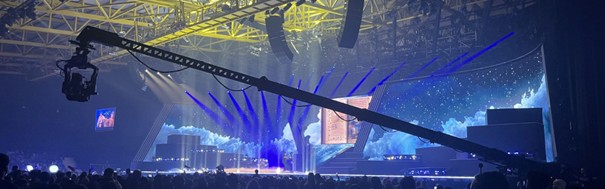
Contrary to the common belief that “the most important things go over the wire,” Wi-Fi became the primary communication medium for hosts, editors, and management personnel during Junior Eurovision.
“Any disruption in operation would have had a direct impact on the live production and the management of the entire event; however, no connectivity issues were reported at any point,” emphasizes Irakli Svanishvili of DTech.
This statement best captures the success of the deployment: the best network is the one that no one has to think about during the event because it simply works.
cnMaestro X: A Command Center on a Single Screen
Managing 60 access points in a dynamic production environment requires precision and real-time data. The project utilized the cnMaestro X platform, which enabled centralized control of the entire infrastructure from a single pane of glass.
This allowed engineers to monitor performance in real-time and respond instantly to any potential network congestion. Just before the event, tests showed throughput exceeding 200 Mbps, giving the team full confidence that the infrastructure could handle any challenge.
Summary
The Junior Eurovision project in Tbilisi proved that modern Wi-Fi 6 and 6E standards from Cambium Networks are ready for the most demanding “mission-critical” scenarios. In just four weeks, a network was created that not only handled extreme device density but also became the foundation for the success of an international broadcast.
If this technology can flawlessly support an event for a million-strong audience and critical TV production systems under extreme pressure, imagine how much it could improve the standards of reliability and performance in your everyday business infrastructure.
Read the full case study: