
Enterprise Wi-Fi 7 Solutions
Key Features
Blazing Fast Performance
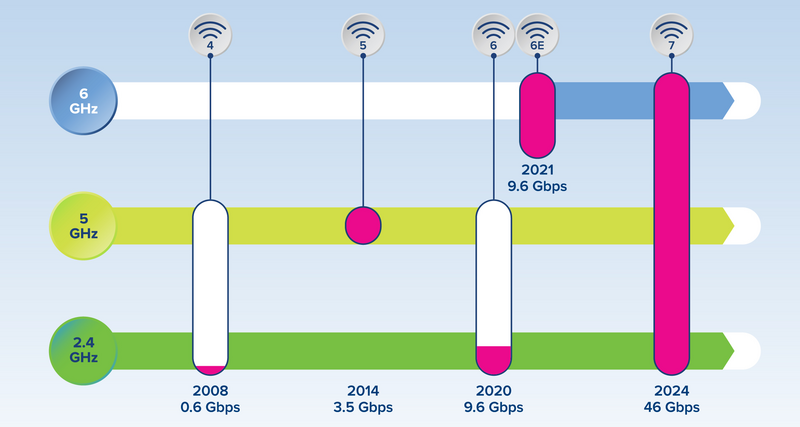
Up to 46 Gbps with wider 320 MHz channels and 4096-QAM modulation.
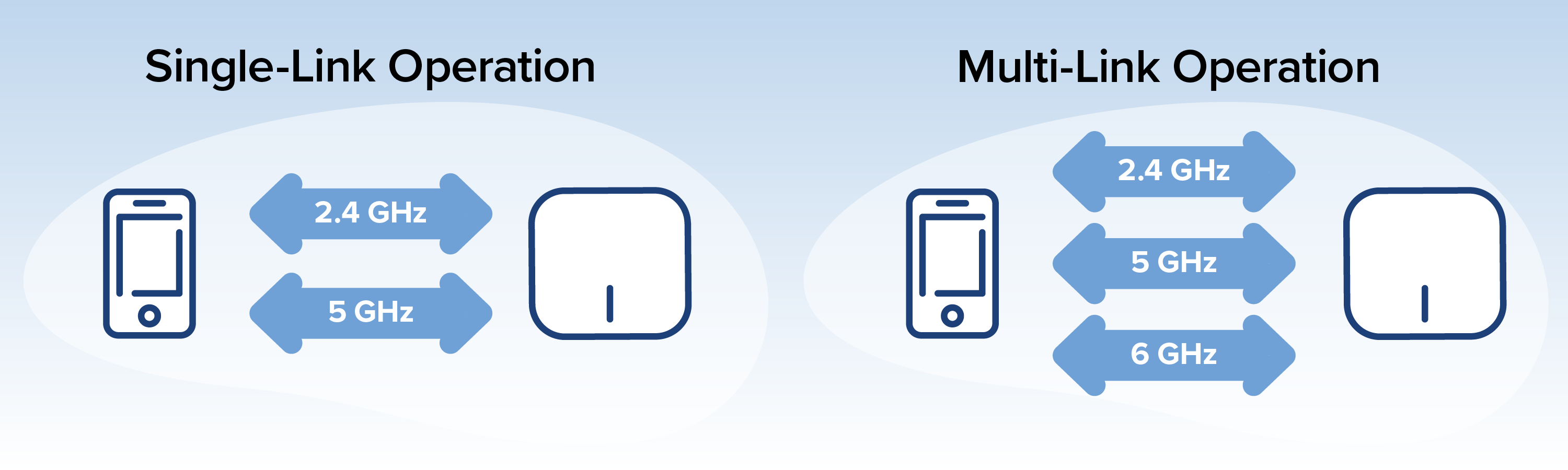
Multi-Link Operation (MLO)
Use multiple frequency bands simultaneously for lower latency and greater reliability.
Higher Capacity
Support more users and devices with improved throughput and efficiency.
Built for AI & Real-Time Applications
Optimized for AI, AR/VR, cloud collaboration, and latency-sensitive workloads.
The Evolution of Wi-Fi
Wi-Fi 7 represents the seventh generation of Wi-Fi, based on the advanced IEEE 802.11be standard. Though the final standard will be ratified in late 2024, Wi-Fi 7 certification began early in 2024, and the first devices are already here. Enterprise networks are rapidly adopting this technology, setting a new benchmark for speed, reliability, and efficiency, enabling cutting-edge applications like AI Automation and Generative AI.
How Wi-Fi 7 Works
Multi-Link Operation (MLO)
- Multi-Link Single Radio (MLSR): Switch channels to avoid congestion with a single radio.
- Enhanced Multi-Link Single Radio (eMLSR): A second radio listens for congestion, optimizing channel switching.
- Multi-Link Multi-Radio Simultaneous Transmit and Receive (MLMR-STR): Transmit and receive simultaneously on multiple radios for maximum efficiency.
- Multi-Link Multi-Radio Non-Simultaneous Transmit and Receive (MLMR-NSTR): Synchronized transmissions on two radios, balancing cost and performance.
Higher Throughput
- Wider Channels: Up to 320 MHz channels in the 6 GHz band.
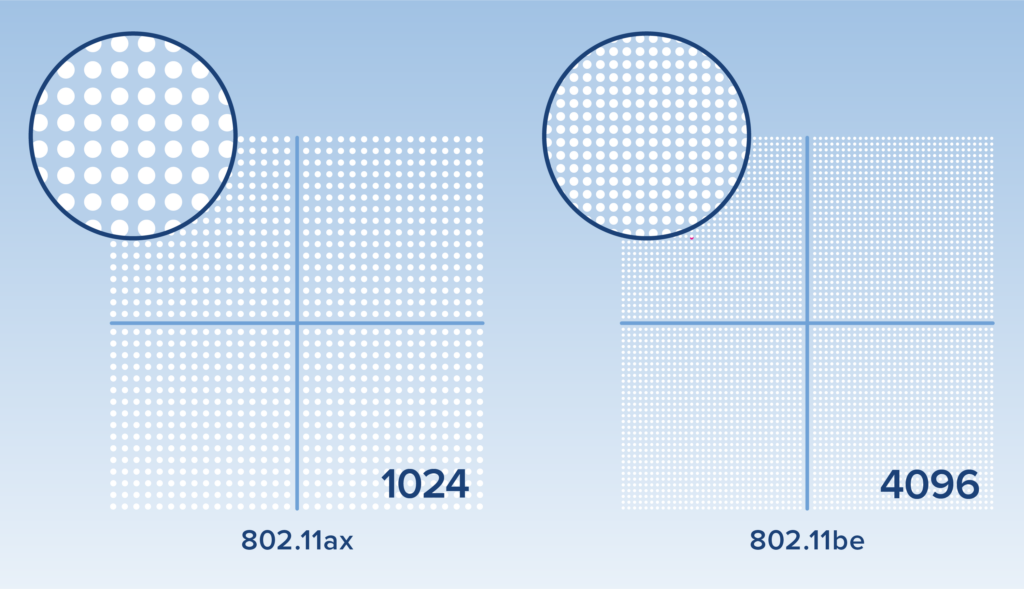
- Higher Modulation: Up to 4096-QAM for a 20% increase in throughput.
- Multiple Spatial Streams: Up to 16, although most APs will use 4 or fewer.
Efficient Data Transmission
- Compressed Block-ack: Acknowledges up to 512 data units simultaneously.
- Multiple Resource Units (Multi RU): Assigns multiple channel chunks to a single client, improving efficiency.
When Should You Upgrade to Wi-Fi 7?
Consider upgrading if your organization would benefit from:
- Faster Speeds – Support bandwidth-intensive applications with speeds up to 46 Gbps.
- Lower Latency – Improve responsiveness for real-time collaboration, AR/VR, and interactive applications.
- Greater Network Efficiency – Increase capacity and performance in high-density environments.
- AI & Immersive Experiences – Prepare for emerging AI, AR, and VR workloads.
- Future-Proof Connectivity – Support the next generation of Wi-Fi 7-enabled devices.
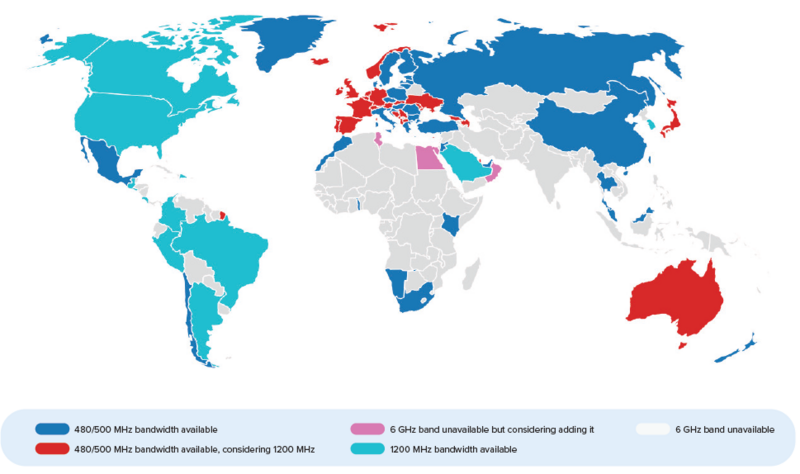
- 6 GHz Performance – Take full advantage of the expanded capacity and reduced interference available in the 6 GHz band.
Deploying Wi-Fi 7 Enterprise Networks
To leverage the full potential, especially in the 6 GHz band:
- Design with Tri-Band APs: Ensure support for 2.4 GHz, 5 GHz, and 6 GHz bands.
- Optimize for Wider Channels: Utilize 80 MHz or 160 MHz channels for enterprise environments.
- Adopt AFC Systems: For indoor and outdoor 6 GHz usage, comply with Automatic Frequency Coordination (AFC) regulations.
Getting Started with Wi-Fi 7
Wi-Fi 7 Solution Guide
Learn how Wi-Fi 7 technologies—including Multi-Link Operation, 4096-QAM, and 320 MHz channels—deliver faster, more reliable wireless connectivity for enterprise networks.
Download Solution GuideAI Network Management Demo
Experience how AI-powered network management simplifies Wi-Fi 7 deployment, optimizes performance, and delivers real-time network visibility.
Launch Interactive DemoWi-Fi 7 Access Points
Explore Cambium's portfolio of enterprise Wi-Fi 7 access points designed to deliver exceptional performance, capacity, and reliability for every deployment.
Explore Access PointsIntroducing Wi-Fi 7 for Enterprise
Resources
More Info
- Cambium Networks Introduces the First in a New Class of Enterprise Wi-Fi 7 Solutions
- Discover the Future of Wi-Fi 7 Technology
- 3 Ways Wi-Fi 7 Will Transform Guest Experiences in Hospitality
- Weighing Whether to Shift to Wi-Fi 7? Read This First
- Discover the Future of WiFi 7 Technology in your Business Operations