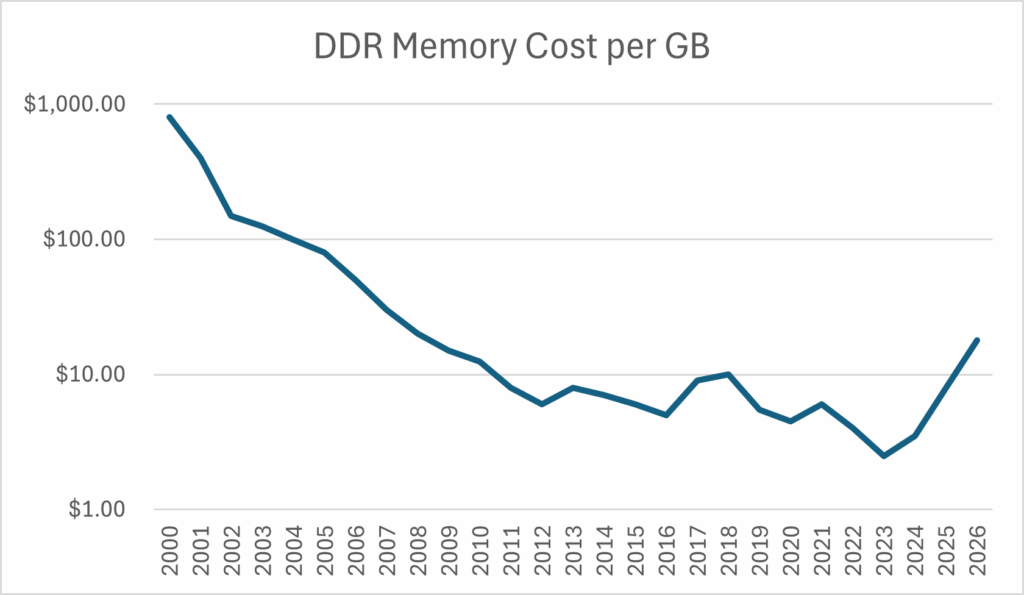
Do you remember when memory prices only seemed to move in one direction… down?
Since 2000, DDR (Double Data Rate) memory has followed a familiar pattern: each new generation more than doubled peak data rates, enabling entirely new classes of applications. But while performance kept accelerating, something else was happening more quietly: each generation took longer to arrive than the last.
Today, nearly six years after the introduction of DDR5, we’re standing on the edge of DDR6.
At the same time, DDR5 is finally hitting the mainstream, driven largely by GPUs powering AI data centers. That combination (delayed generational shifts and explosive AI demand) is creating enormous pressure on the memory supply chain. Manufacturers are reallocating capacity to support higher-margin, AI-driven products, and that shift ripples backward through earlier generations.
The numbers tell the story. In 2023, DDR4 and DDR5 hit an all-time low of roughly $2.50 per GB. Less than three years later, prices have climbed to $18 per GB, a dramatic reversal by any measure.
We’ve seen this movie before.
Historically, while the long-term trend for memory cost per GB has been downward, there have been notable peaks, most notably in 2013 and 2018. Those cycles offer a useful model for where we are today, suggesting this shortage could persist for one to two years before stabilizing.
This isn’t just a data center problem. Memory touches virtually every electronic device, and the telecommunications industry is no exception. As costs rise and supply tightens, we should expect higher pricing, sporadic delays, and occasional surges that challenge even well-run supply chains.
At Cambium, we’re taking a proactive approach grounded in three core principles:
- Planning further ahead by buying earlier and with greater foresight
- Using less memory through more efficient resource utilization
- Qualifying more vendors so we can adapt quickly to available supply
No single strategy is sufficient on its own and nothing will prevent increases in costs. However, the combination of all three (planning, efficiency, and flexibility) will help us navigate the shortages ahead and emerge in a better position on the other side.
Memory is getting more expensive again, but a thoughtful strategy will pay significant dividends.